R&D Engineer at VITO Remote Sensing

Ioannis Kalfas

Senior AI Engineer: GeoAI, computer vision, edge AI & production ML

I take computer-vision and Earth-observation systems from research prototype to operational deployment, from insect-monitoring devices in the field to global 10 m land-cover maps for Copernicus.

  • Leuven, Belgium
  • Greek · EU national
  • PhD, KU Leuven
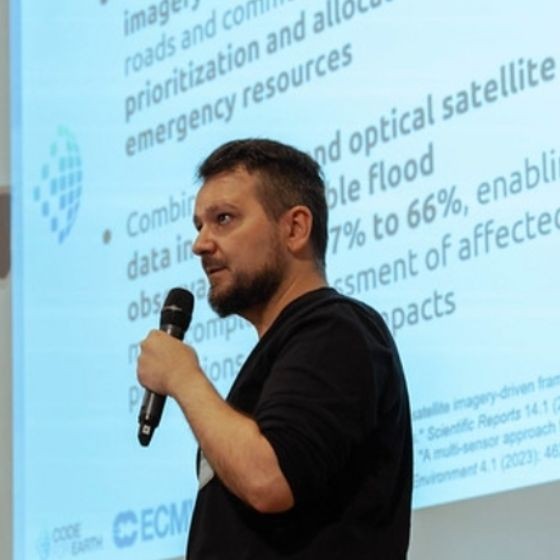
Ioannis Kalfas presenting satellite-based flood mapping work on stage
On stage at ECMWF Code for Earth 2026
11yrs
building AI systems across R&D, academia and industry
9
peer-reviewed publications, 5 as first author
10m
resolution global land-cover maps for Copernicus LCFM
8+
master’s and bachelor’s theses supervised

About

From research prototypes to operational systems

I’m Ioannis (Yannis) Kalfas, a Senior AI Engineer and PhD with 11 years of experience building computer-vision and GeoAI systems. My work combines deep-learning model development with data engineering, reproducible MLOps, and optimization for cloud, edge and embedded environments.

At VITO, I developed and operationalized global land-cover and cloud-screening workflows for the Copernicus LCFM programme, then moved to the GeoAI and Edge Solutions team to work on efficient models for resource-constrained edge and onboard computing.

My path runs from modelling biological vision with deep CNNs, through industry AI and field-deployed insect monitoring, to planetary-scale Earth observation. What ties it together is connecting scientific modelling, maintainable software and production infrastructure across multidisciplinary teams.

  • Research → production

    Models that ship: global EO products, an AWS-hosted serving platform, Raspberry Pi field devices.

  • Efficient & edge AI

    Neural image compression (VQ-VAE) that balances model footprint against spatial and spectral fidelity.

  • MLOps & data engineering

    Reproducible training (MLflow, Hydra, Pydantic) and distributed pipelines on Spark, Hadoop and GPU clusters.

Career at a glance

From neurons, to insects, to satellites.

  • Neuroscience
  • Industry
  • Agri-food & bio
  • Earth observation

Experience

Eleven years across R&D, academia and industry

R&D Engineer

VITO · Remote Sensing unit · Mol, Belgium

Mar 2024 – Present

GeoAI and Edge Solutions

Current Jan 2026 – Present
  • Optimize and evaluate CORSA VQ-VAE architectures for satellite-image compression, balancing model footprint with spatial and spectral reconstruction quality on resource-constrained edge and embedded platforms.
  • Develop internal MLOps tools for experiment tracking, reproducible configuration, and job management on VITO’s on-premises GPU cluster.
  • Build parametrized training workflows with PyTorch, MLflow, Hydra and Pydantic to improve experiment reproducibility and model traceability.
  • PyTorch
  • VQ-VAE
  • MLflow
  • Hydra
  • Pydantic
  • GPU cluster

Remote Sensing Applications

ESA WorldCover & Copernicus LCFM team Mar 2024 – Jan 2026
  • Developed deep-learning models for cloud segmentation and global 10 m land-cover mapping within the Copernicus Land Cover and Forest Monitoring programme.
  • Built multi-stage pipelines for satellite-data ingestion, preprocessing, model inference, and generation of annual global Earth-observation products.
  • Implemented reusable cloud-model inference workflows across local, AWS and openEO environments.
  • Engineered distributed data pipelines using Hadoop, Spark, object storage and network storage for geographically and seasonally diverse satellite datasets.
  • Improved model operationalization through MLflow integration, package maintenance, output validation, and standardized GeoTIFF metadata.
  • Supported technical handover by guiding colleagues through model configurations, datasets, annotation sources, training code and inference workflows.

  • Semantic segmentation
  • Sentinel data
  • Spark
  • Hadoop
  • AWS
  • openEO
  • GeoTIFF

PhD Researcher → Postdoctoral Researcher

KU Leuven · MeBioS, Biosystems · Leuven, Belgium

Dec 2018 – Mar 2024

Postdoctoral Researcher

Nov 2022 – Mar 2024
  • Built and deployed an AWS-hosted image-classification, annotation and model-serving platform used by research teams and external collaborators.
  • Led the adoption of shared Git infrastructure and software-engineering practices across multiple research teams.
  • Organized bimonthly deep-learning meetups for researchers across departments, communicating technical concepts to interdisciplinary audiences.
  • Managed multi-terabyte research datasets through KU Leuven’s ManGO platform, improving dataset organization and accessibility.
  • Investigated hyperspectral imaging and machine-learning methods for early disease detection in agri-food applications.

PhD Researcher in Pest-Insect Identification

Dec 2018 – Nov 2022
  • Designed multimodal datasets and training pipelines for optical and acoustic insect identification using image and time-series data.
  • Developed deep-learning models for Raspberry Pi devices and integrated them with an AWS-hosted API serving external research collaborators.
  • Supervised more than eight master’s and bachelor’s thesis students in computer vision and signal processing.
  • Published five peer-reviewed papers on AI-driven biological monitoring.
  • PyTorch
  • CNNs
  • YOLO
  • Time-series
  • Hyperspectral
  • Raspberry Pi
  • AWS
  • FastAPI
  • Docker

Data Scientist / AI Engineer

Faktion · Antwerp, Belgium

Dec 2017 – Dec 2018

  • Developed end-to-end machine-learning solutions for industrial computer vision, speech processing and predictive-maintenance use cases.
  • Standardized feature-extraction and data-preparation workflows for heterogeneous client datasets, improving consistency and reuse across projects.
  • Won an industry hackathon by developing a video-based activity-recognition prototype.
  • Computer vision
  • Signal processing
  • Predictive maintenance
  • scikit-learn
  • OpenCV

Doctoral Researcher in Computational Neuroscience

KU Leuven · Neurophysiology · Leuven, Belgium

Nov 2015 – Nov 2017

  • Investigated deep convolutional networks as computational models of biological visual processing.
  • Developed computer-vision and regression models to predict neuronal responses to visual stimuli.
  • Published four peer-reviewed papers, including two as first author, and presented at the Vision Sciences Society conference before leaving the programme to pursue applied AI in industry.
  • Deep CNNs
  • Neural encoding models
  • Regression
  • Python

Selected work

Projects, from orbit to the field

Project Atlantis

ECMWF Code for Earth 2026 · with Stylianos Lagaras · May – Aug 2026

A scalable STAC/Zarr pipeline for ML-ready, multi-source flood inundation observations, built during ECMWF Code for Earth, an innovation programme where developer teams work with ECMWF mentors on open-source Earth-science software.

It harmonises flood observations from VIIRS and MODIS (optical) and GFM (Sentinel-1 SAR) onto a common 1-arcmin grid, with a CLI, a Python API and a consolidated archive. The repository includes a worked example on the 2024 Valencia floods.

Mentors

Stack

  • Zarr
  • STAC
  • xarray
  • SAR
  • Optical EO
  1. VIIRS + MODIS + GFM
  2. Harmonised 1-arcmin grid
  3. Zarr / STAC archive
  4. ML-ready flood data

CORSA: edge satellite-image compression

VITO · GeoAI and Edge Solutions · 2026–

Optimizing VITO’s lightweight VQ-VAE compression model so satellite imagery can be compressed on edge and embedded hardware, trading model footprint against spatial and spectral reconstruction quality. Alongside it, I build the MLOps tooling for experiment tracking and GPU-cluster job management.

  1. Satellite images
  2. CORSA compression (edge)
  3. On-prem GPU cluster

LCFM: global 10 m land cover

VITO · Copernicus programme (€11M) · 2024–2026

Multi-stage AI pipelines producing annual global land-cover maps at 10 m resolution, ten times sharper than before, in support of EU environmental policy and climate monitoring. I focused on the cloud-segmentation models that identify usable observations and on deploying the classification models.

  1. Satellite data
  2. AI cloud detection
  3. Quality composites
  4. Global land-cover maps

Open source

Tools I build and maintain

Python tools that came out of day-to-day research and engineering work.

Skills

Technical toolkit

GeoAI & computer vision

  • Satellite imagery
  • Semantic segmentation
  • Image classification
  • Cloud screening
  • Land-cover mapping
  • Multispectral & hyperspectral
  • YOLO
  • OpenCV

Edge & efficient AI

  • VQ-VAE
  • Neural image compression
  • Model optimization
  • Constrained inference
  • Raspberry Pi
  • Embedded deployment

ML engineering & MLOps

  • PyTorch
  • PyTorch Lightning
  • MLflow
  • Hydra
  • Pydantic
  • scikit-learn
  • TensorFlow / Keras
  • Experiment tracking
  • Model validation

Data engineering

  • Spark
  • Hadoop
  • Pandas
  • xarray
  • GeoTIFF
  • Zarr / STAC
  • Distributed processing
  • Large-scale ETL

Cloud & infrastructure

  • AWS EC2 / S3
  • Docker
  • Linux
  • Bash
  • FastAPI
  • REST APIs
  • On-prem GPU clusters
  • Git

Data apps & languages

  • Streamlit
  • NiceGUI
  • Solara
  • Flask
  • Greeknative
  • Englishprofessional
  • Dutch · Spanish · Swedishelementary

Publications

Nine peer-reviewed papers

Across computer vision, bioscience AI and computational neuroscience. Full list on Google Scholar.

  1. 2023
    Towards automatic insect monitoring on witloof chicory fields using sticky plate image analysis

    Kalfas I., De Ketelaere B., Bunkens K., Saeys W.

    Ecological Informatics 75, 102037First author

  2. 2023
    An introduction to artificial intelligence in machine vision for postharvest detection of disorders in horticultural products

    Tempelaere A., De Ketelaere B., He J., Kalfas I., Pieters M., Saeys W., et al.

    Postharvest Biology and Technology 206, 112576

  3. 2022
    Optical identification of fruitfly species based on their wingbeats using convolutional neural networks

    Kalfas I., De Ketelaere B., Beliën T., Saeys W.

    Frontiers in Plant Science 13, 812506First author

  4. 2022
    A fresh look at computer vision for industrial quality control

    De Ketelaere B., Wouters N., Kalfas I., Van Belleghem R., Saeys W.

    Quality Engineering 34(1), 152–158

  5. 2021
    Towards in-field insect monitoring based on wingbeat signals: the importance of practice oriented validation strategies

    Kalfas I., De Ketelaere B., Saeys W.

    Computers and Electronics in Agriculture 180, 105849First author

  6. 2019
    The ventral visual pathway represents animal appearance over animacy, unlike human behavior and deep neural networks

    Bracci S., Ritchie J.B., Kalfas I., Op de Beeck H.P.

    The Journal of Neuroscience 39(33), 6513–6525

  7. 2018
  8. 2017
    Shape selectivity of middle superior temporal sulcus body patch neurons

    Kalfas I., Kumar S., Vogels R.

    eNeuro 4(3)First author

  9. 2017
    Representation of semantic similarity in the left intraparietal sulcus: functional magnetic resonance imaging evidence

    Neyens V., Bruffaerts R., Liuzzi A.G., Kalfas I., Peeters R., Keuleers E., et al.

    Frontiers in Human Neuroscience 11, 402

Education

Three countries, three degrees

  1. 2018 – 2022

    PhD, Bioscience Engineering

    KU Leuven, Belgium

    Optical insect identification with signal processing, computer vision and deep learning.

  2. 2015

    MSc, Machine Learning

    KTH Royal Institute of Technology, Stockholm, Sweden

    Specialised in computational neuroscience and spiking neural networks.

  3. 2013

    BSc, Computer Science

    Aristotle University of Thessaloniki, Greece

    Foundations in computing theory and information systems.

Leadership & community

Beyond the code

  • Mentoring

    Supervised 8+ master’s and bachelor’s theses in computer vision and signal processing.

  • Deep-learning meetups

    Organised bimonthly meetups for researchers across KU Leuven departments.

  • Engineering practices

    Led the adoption of shared Git infrastructure and software-engineering practices across research teams.

  • Speaking

    Vision Sciences Society (Florida, USA) and ECMWF Code for Earth 2026.

  • Hackathon winner

    Video-based activity recognition prototype at an industry hackathon.

  • Open-source maintainer

    desto, vresto, plakakia and filoma, tools in active research use.

Contact

Let’s talk

I’m always interested in how AI can improve our lives, especially in GeoAI, efficient models on the edge, and turning research into dependable systems. Email is the best way to reach me.